Echo sisters
Upcoming exhibition
ART BALI
September , 2026
Echo sisters is a female collaborative project by Anastasia Naassan and Ksenia Egereva — two practitioners who share a background in psychology and a sustained interest in how human relations shape perception, behavior, and choice. Working together functions as a chamber of resonance: ideas mirror, collide, and transform, allowing them to maintain a plural voice where authorship becomes relational rather than individual.
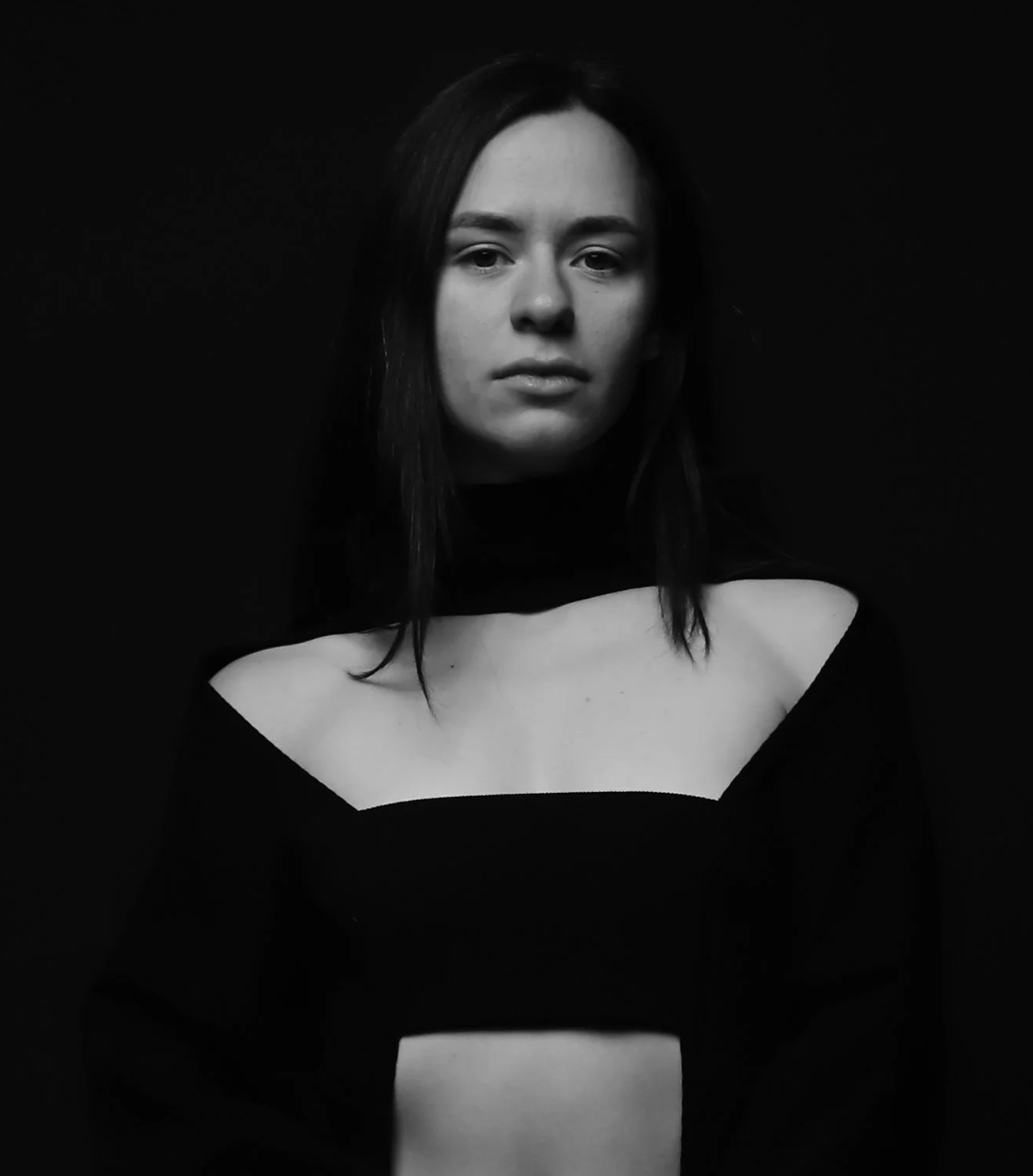
Anastasia Naassan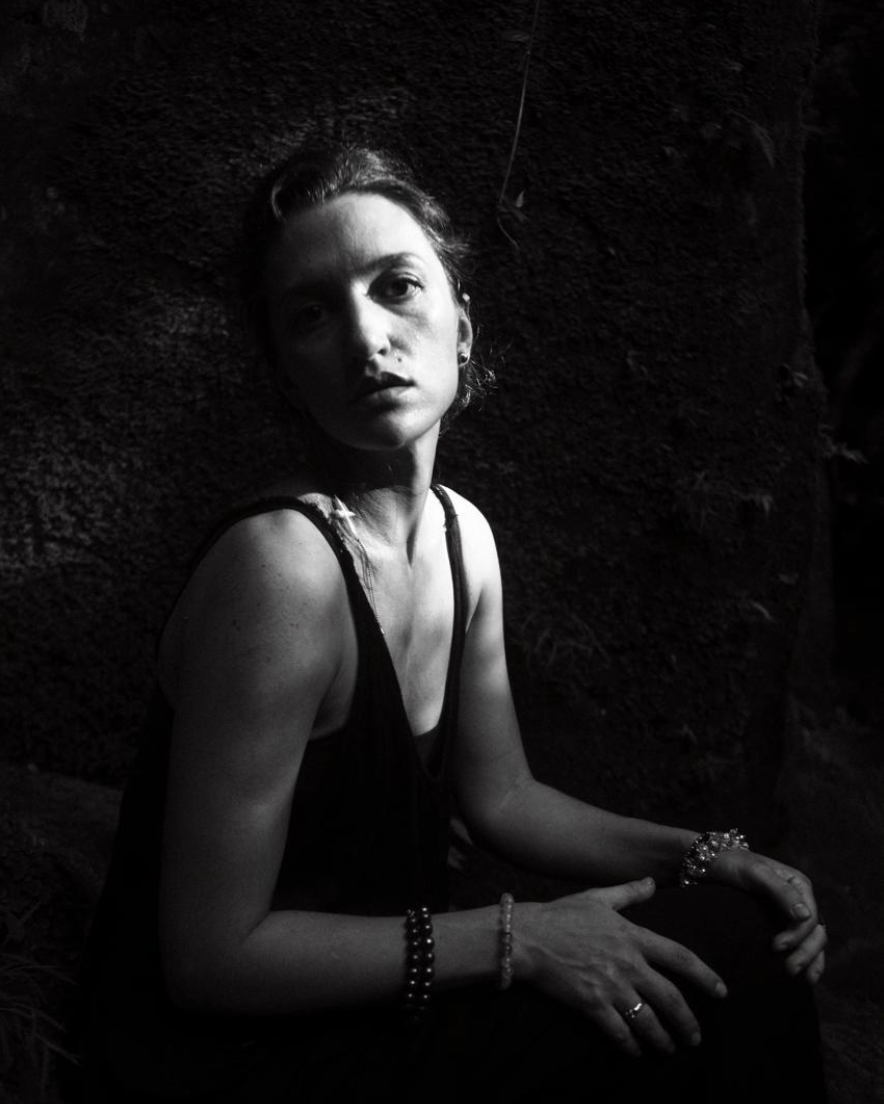
Ksenia Egereva01/ P E R F O M A N C E
CONTREFORCE
20 min · 2 performers · winches, ropes, live computation, screens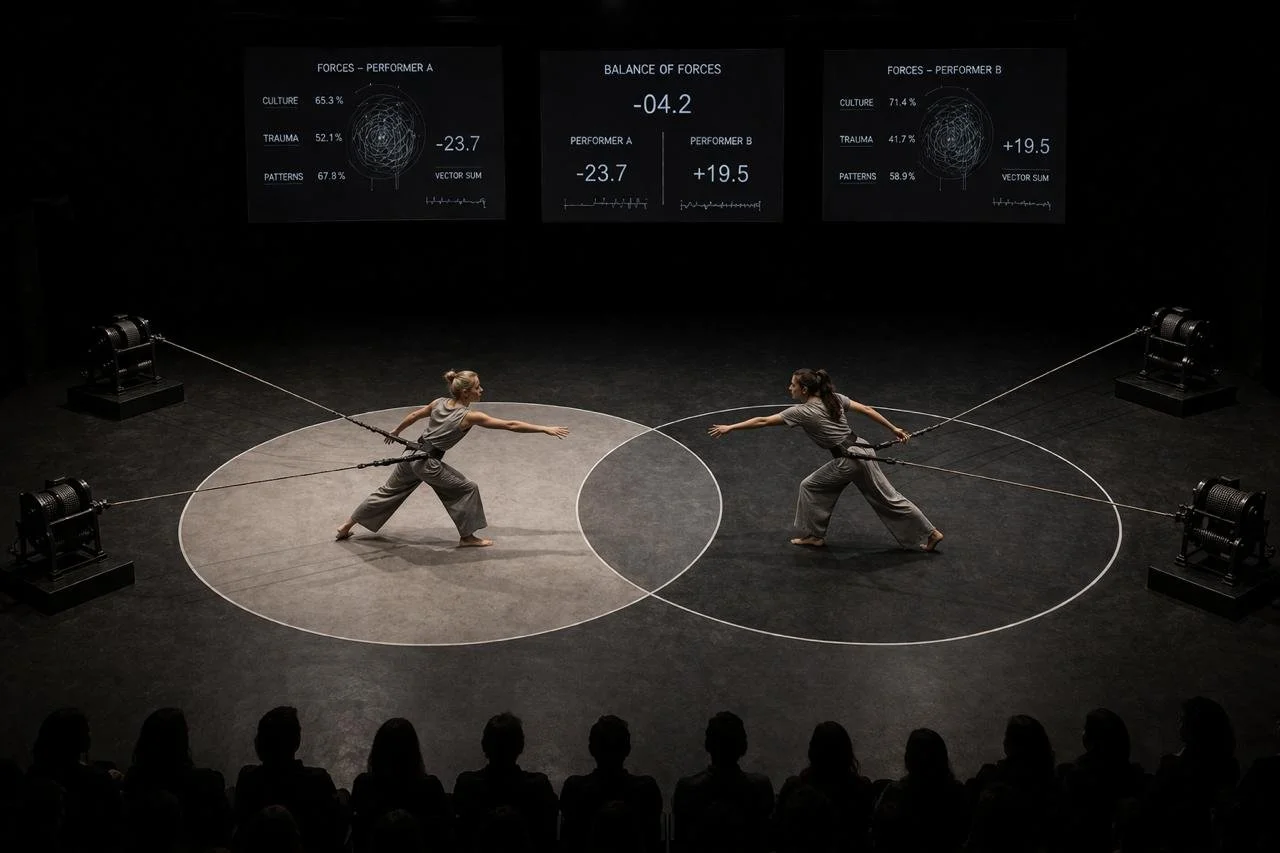
Two performers move within intersecting circles each divided between a light and a dark side — marking the bright and dark dimensions of a person. Each strives toward their lighter side and foward meeting the other.
At the same time, each is pulled by forces they do not govern: culture, trauma, unconscious patterns. These forces are materialized as winches and ropes connecting to the belt exerting competing tension on the performers' bodies. Screens visible to the audience — but not to the performers — display randomized calculations showing the shifting balance of forces in real time.
The question the work poses is simple: will the two reach each other? For how long? Closer to light or to shadow — when they do? The performance does not resolve. It holds the question open.
02/ I N S T A L L I A T I O N
THE VASE
object installation · human scale · glassed mixed media · 13 flowers-archetypes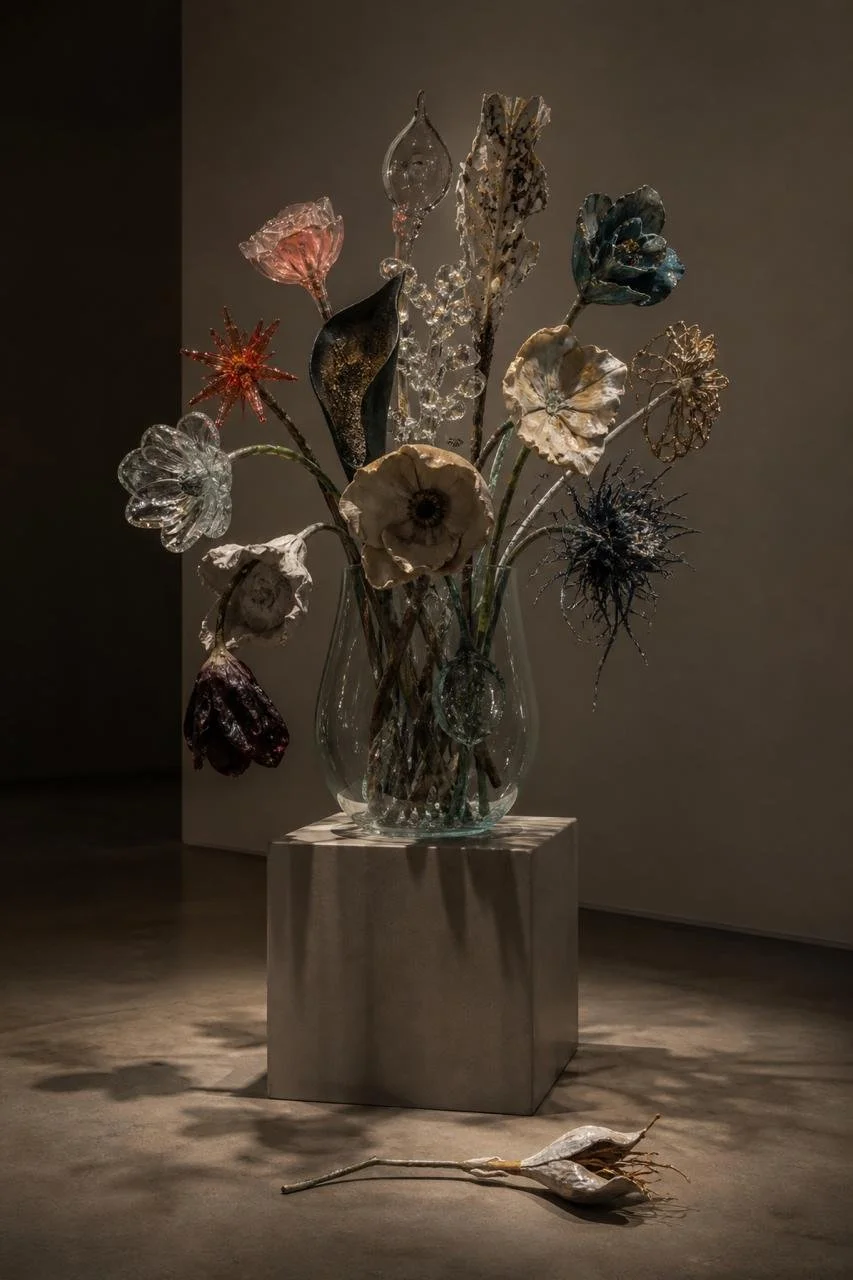
A human-scale object installation: a glass vase contains glass wood ceramics mixed media. Twelve are gathered together; the thirteenth lies on the floor, fallen from the whole. Each flower is realized in its own material and form: some remain recognizably alive and in bloom, others are distorted, sharp, exhausted, or barely holding their shape.
The flowers embody not characters but archetypal structures of experience — recurring inner patterns that arise where the self is disrupted: in fear, love, death, transition, loss, or contact. The bouquet exists simultaneously as an image of a person and of humanity: a composition of parts that hold, conflict, attract, and resist one another. The fallen flower is a part that has lost connection with the whole, without losing its own nature.
Where is the boundary between part and whole? What keeps us in composition — and what makes us fall out of it? Is it possible to remain connected to the common without disappearing inside it?